Saturday, July 31, 2010

a day in the life.

I know I make my time here in China seem really glamorous, but the truth is, a typical day here really isn't all that different from something you would experience in the States.

I get up everyday around 7:30 AM, shower (if the hot water is cooperating), and usually set up for a skype date with my parents around 8:00 AM. I probably talk to them more here than I do while at Northwestern despite being so close to home. The fact that I can't pick up a phone and call them whenever I want only makes me want to call them more.

While skyping, I simultaneously get ready, eat breakfast, and finish my homework. I'm out the door at 8:45 and then it's a 3 minute bike ride between me and the 8:55 school bell. In the mornings we have three consecutive periods of Chinese class. That's my teacher, Shui Laoshi, on the left. She's always smiling and laughing and is a fantastic teacher--I'm going to miss her when we leave.

In between classes, we have two short breaks. Typically on the first break everyone migrates down to the market in the basement of c-lou (literally "C Building" in Chinese). As you could have guessed this building is shaped like a giant "C" and houses anything you could possibly need. We take classes on the 2nd floor, and on the first and basement levels there is a bank, a post office, a phone store, an apple store, a bookstore, and our favorite, the convenient store. You can get everything from snacks and fruit to laundry detergent to a bathrobe there. Usually we just stock up on fruit or our favorite Chinese snacks and then head back upstairs and hang out in the hallway until the bell rings. It really brings me back to high school, minus all the insecurity and stress.

After class is done, our teachers join us for lunch at one of the many restaurants on campus. Gu Laoshi makes the reservations, pre-orders for us, and we all share the many dishes family-style. Lunchtime is another way for us to practice our Chinese outside of the classroom. We ask them about the dishes we're being served-- Zhe shi shenme?--as well as ask their advice on sites to visit, where to eat, and places with the best shopping.

In the afternoons, for the first four weeks I had my class on Traditional Chinese Medicine; we'd commute to Capital Medical University to hear lectures from professors or travel to TCM pharmacies and hospitals. Weeks 5 and 6 of the second session we had a very abbreviated class on Public Health in China. We had five trips to nearby hospitals and paid a visit to the Beijing CDC--and then we were done. Easiest credit earned at Northwestern. Now, in the last two weeks of the trip, I only have my morning class. So I spend my afternoons reading, blogging, napping or watching movies.

We've gotten into a routine of eating in the dining halls during the week. The government subsidizes the cost of the food, and thus it is much cheaper than eating in restaurants in Wudaokou. Typically my dinner consists of rice or noodles and watermelon, which ends up being about 5 kuai--less than $1 US.

After dinner, if we have a ton of work to do we'll either set up camp at a cafe and work or do work in the dorms. Typically on weeknights if we go out it's someplace nearby like Lush, Pyro, La Bamba, Propaganda, etc. Every Wednesday you'll find us at Lush, getting slaughtered at the Pub Quiz. It's basically a trivia contest with five rounds each with a different theme, but nearly every other team has a good 5-10 years on us. We pride ourselves on the fact that we've never finished dead last.

And that's what a typical weekday is like here. Saturdays we have excursions during the day and are have an opportunity to experience the night life in places farther from campus. Sunday is our "rest day," so we get to sleep in and plan our own outings.

I like the routine I've fallen into for the past six weeks. It makes Beijing feel a little more like home. And the best part is we're so busy that this summer is absolutely flying by!

Friday, July 30, 2010

Save the Pandas!


"Is it dead?"
"No, no, I think it's just sleeping"

It's never a good sign if, at a zoo, you're are constantly left to wonder if the animals are, in fact, alive. Our day at the Beijing Zoo was overall pretty depressing. We were shocked at how lackluster the animals' habitats were. The spaces for the the Lions and Tigers in the Cat house were fours walls of cement enclosed by metal bars--something more akin to a jail cell than a space suited for an animal.

The majority of cages and habitats were neglected and unkempt; there was rotting food and litter scattered the cement and dirt. The cages were poorly ventilated, and on the 100+ degree day the animals looked so hot they couldn't bear to move.

The overwhelming lack of respect for the well-being of the animals became clear to us soon after arriving. Where glass separated animals from the onlookers, parents would join their kids in banging on the windows to get the animals' attention (likely the cause of the many broken and cracked windows we encountered throughout the day). While looking from above at the hippos cooling off in the murky water, we watched in utter shock as people thrw their trash in the pool without a second thought.

We walked around for a bit, but couldn't stand the heat or the condition of the zoo any longer.

The only fond memory of the day was when I got to sit next to a very well-behaved chimpanzee to pose for a souvenir photo. The way the trainer (pictured left) interacted with the chimp made me hopeful that there was at least one animal at the Beijing Zoo getting the attention it deserved.

Tuesday, July 27, 2010

Jingshan and Beihai Parks


Our excursions last weekend were to two parks just outside of Tiananmen Square: Jingshan and Beihai Parks.

First was Jingshan Park, which boasts the highest point in Beijing, providing great views of the Forbidden City. This hill is actually artificial and was made from the leftover dirt dug out during the construction of the moat that surrounds the Forbidden City. That's us and Gu Laoshi standing at a Pavillion at the highest point that overlooks the Forbidden city.

Jingshan is a popular gathering place for elderly people; right as we entered the park grounds we saw a group of elderly women doing traditional Chinese fan dancing.

Beijing is in the midst of a heat wave (and we thought it couldn't get any hotter), so much of the day was spent taking refuge in shady pavilions that overlooked old Beijing.
When the older parts of the city were being built, the major buildings of Beijing were built along a central axis, with Tiananmen Square and the Forbidden City at the center; Jingshan lies just north of the Forbidden City along this axis. Another point of interest: Within Jingshan Park is the tree on which Emperor Chongzhen hung himself after a peasant uprising.

Next it was on to nearby Beihai Park, which is an imperial garden. Beihai, meaning literally "Northern Sea," is located northwest of the Forbidden City with a lake that covers more than half of the entire park. We walked around the perimeter of the lake, taking occasional breaks to appreciate the enormous lotus flowers that densely populate the water. We grabbed a quick lunch, and then decided to stay in the area around Tiananmen and explore.

Our first stop was the Beijing Planning Exhibition Hall, which we'd read about in one of our guidebooks. This museum of sorts was designed to showcase the long history of the city of Beijing, displaying both ancient and modern achievements of design and development. It seems more suited for a cocktail hour with dignitaries than a place you'd want to spend the day exploring. The hall was sort of empty and the exhibits somewhat sparse, but we nonetheless spent hours there reveling in the air-conditioning, cushy seating, and pristine bathrooms.

My favorite part by far was the scale model of Beijing. At the center of this exhibit (pictured) is a 3D model of Beijing's downtown, built to scale; around the perimeter are sky-view photos of the rest of the city. We were even able to locate Tsinghua's campus amongst the 1,000 square-meters of photos.

We had originally planned to eat at a renowned dumpling restaurant, but after a fruitless search in the sticky heat, we settled for the closest restaurant we could find. After dinner, we explored the nearby hutong and did some shopping. Having stumbled upon a small tea shop, we spent a lot of time sampling different teas ("Mythic Fungus" was not one of them). I left with Jasmine, Rose Hips, and Lychee Black Tea.

Overall, a successful day. Though I didn't drink much tea before I came here, I am now a loyal convert. Once I'm back in the States, I can't wait to savor my tea in a newly-purchased tea mug as a fond memory of my time here.

Sunday, July 25, 2010

Xi'an: Day 3

Our last day in Xi'an was filled with some light, local sight-seeing. We had three pagodas on the agenda: The Drum, Bell, and Giant Wild Goose Pagodas. It was a hot day, and we weren't all that thrilled at the prospect of being shuttled from pagoda to pagoda, so we checked out the first two from the outside. Pictured on the right, is the Drum Pagoda.

After the pagodas, we had about an hour to explore Muslim Street. Fun Fact: There is a small population of about 80,000 Muslim Hui People (who are Chinese but practice Islam) living in Xi'an. Most are direct descendants of Silk Road travelers. It was really quite interesting; most of the signs had, of course, English, but there were translations in Arabic as well. I got a kick out of it. File that under "things I never expected to see in China."

Muslim street could be called a smaller version of Silk Street: lots of shops with plenty of souvenirs, t-shirts, and designer knockoffs. And, just like at the Silk Market, you can bargain!

Though at first I was intimidated by whole concept of bargaining, I've become quite a tough negotiator. Dad-you would be so proud. I think I've also benefited from being in China for so long. We've done A LOT of shopping, so I know what is a fair price and what isn't. I've started to build up my arsenal of bargaining techniques. The old "I paid 10 quai less for the same thing at such and such market" is always an effective tactic. Or even something as simple as walking away. When the vendors come chasing after me, I know I've gained the upper-hand.

When we had finished shopping, it was on to the Giant Wild Goose Pagoda. Though, like its name implies, this Buddhist pagoda is giant, it is neither wild nor shaped like a goose. Needless to say, I was disappointed. We walked around for a bit, but since it was a sweltering day and we'd already visited a few Buddhist temples, the Giant Wild Goose Pagoda was kind of old news.

We took a long break in a beautiful, shady pavilion, and recharged for the long day of traveling we had ahead of us. After some persuasion, we convinced our guide (who was a little high-strung) that we had time to stop at the Dairy Queen in the nearby "Happy Mall."As you might imagine, DQ on a hot summer day was the perfect pick-me-up.

Our guide was worried about making it to the train station on time, so we ended up waiting for nearly two hours to board our train. Since I had neglected to pack anything to entertain myself, Sara was kind enough to loan me her extra book, I Hope They Serve Beer in Hell. It made for quite an interesting read. If you're a frat boy, you'd probably really enjoy it.

Once we'd boarded our train, we spent the few hours we had before lights out reading, snacking, chatting, and hanging out. We were all in the same compartment this time around, so it had that fun, junior-high-sleepover feel. Around 10:00 PM I took a Nyquil and called it a day.

Our train arrived in Beijing around 6:30 AM, we piled into cabs, and arrived back on campus around 7:30 AM. I barely had time to shower and eat breakfast before I had to be at Chinese class at 9:00. With a few strong cups of coffee, I made it through an entire day of class, but only barely.

And so ended our midterm trip to Xi'an. Back to the reality of class and homework and dining halls.

Xi'an: Day 2

En route to our only destination for the day, Huashan Mountain, we came to a standstill about an hour into our ride. Our driver, affectionately known as Tony (in the striped shirts and man-pris), waits impatiently for traffic to start moving.

Unfortunately, we were stopped on the highway for nearly two hours, with no idea as to what keeping us from moving. We finally got moving, but for reasons still unknown, the entire highway was closed off. We were forced to take rural roads through poor neighborhoods and farmland. In all, it took us almost five hours to get to the mountains.

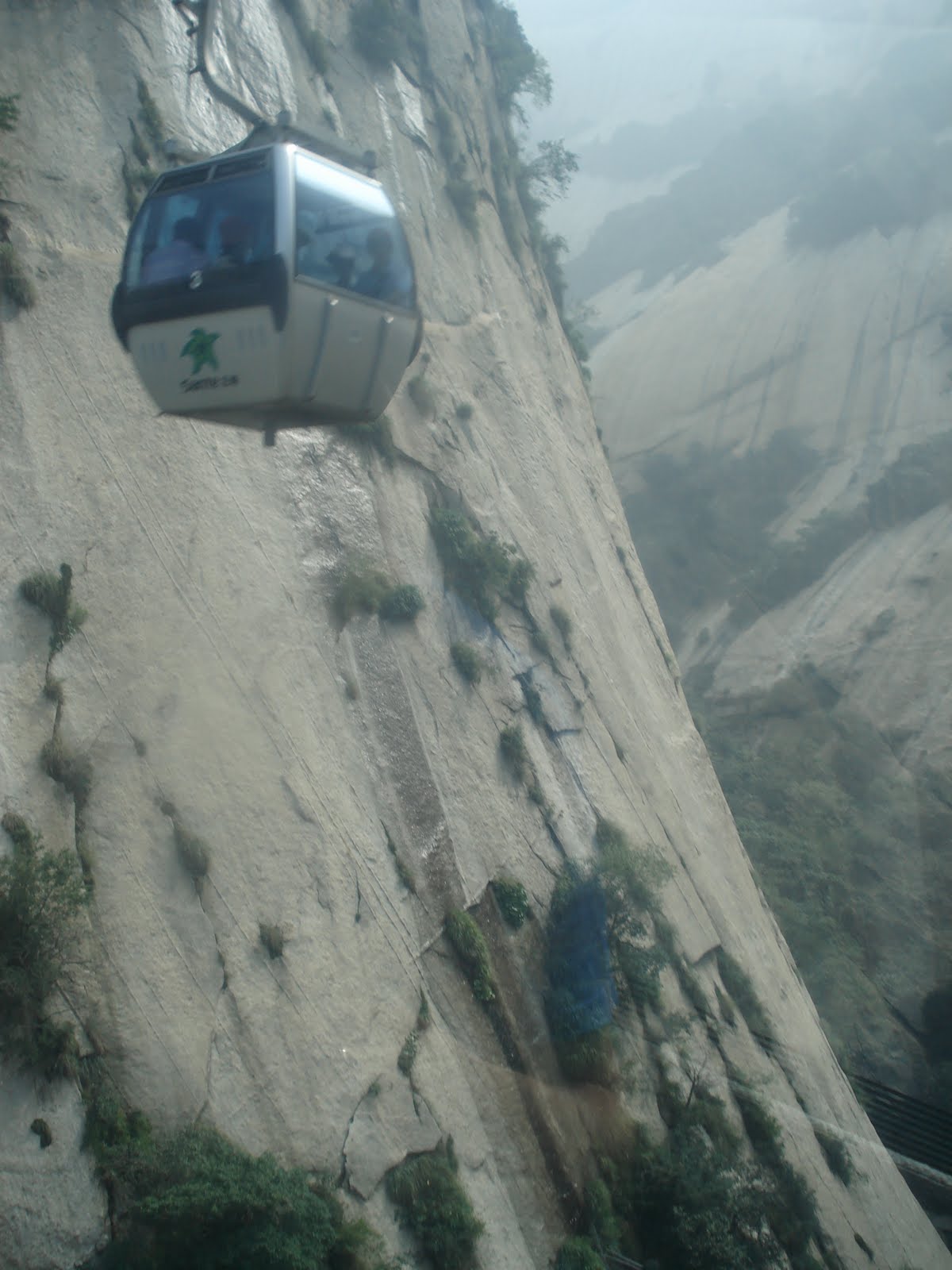
After a quick lunch, we began our journey up to the mountain. A shuttle bus took us to the base, and once we were there, we had to choose between climbing the stairs up to a much lower part of the mountains or take the cable car all the way to the top. It was a tough choice.

Huashan Mountain is staggering at more than 7,000 ft. The ride on the cable car up through the mountains was enough cause our tour guide to start shouting "I hate my job! I hate my job!" Which was not comforting in the slightest to me as I was having my own meltdown. I eventually got over my fears, our guide, however, was shaken enough to get on the next cable car back down the mountain.

The views from the top were spectacular. There were stairs and paths built into the mountains--there were even restaurants and hotels! We slowly journeyed up to the very top of the south peak.

Along the chain-link guard rails we hundreds of locks and red ribbons. It is popular among couples to buy locks inscribed with their names, attach the lock to the chain, and throw the key down the side of the mountain as a symbol of commitment. The red ribbons stood for good luck.

It was a sunny day, and by the time we reached the top of the mountain, we were soaked with sweat. We took a long break at the top, enjoying a cool breeze and even cooler drinks.

Having thoroughly taken in the magnificent views, we began our journey down the mountain a la a second ride down on the cable car. We ate a late dinner at a nearby restaurant and started our long ride home.

It was a quiet ride, but thankfully the highway had reopened, and much of the ride was spent sleeping. It had been an exhausting day and we need a good night's rest before our day in Xi'an and a long day of traveling ahead of us.

Gu-ism #3


"If the water is too clean, no fish will want to come."


Friday, July 23, 2010

Xi'an: Day 1

When we got to the hotel, our rooms weren't available yet, so they brought us to a charming room to rest in before a jam-packed day of sight seeing. The room was literally wall-to-wall beds, the paint was chipping off the walls, and there were dead mosquitos on the wall. Calling it a hellhole would be generous.

After seeing this room, we did not have high hopes for where we would be staying. Thankfully, our actual rooms were much nicer than this one.

A quick nap and then it was off to our first destination: the City Wall. Xi'an is an ancient city and is entirely surrounded by a brick wall about 12 meters high. We walked along the wall for a while and then checked out some of the exhibits in the interior of the wall.

We quickly learned that Americans are surprisingly few and far between in Xi'an, and, thus, we were approached many times throughout the day by Chinese tourists wanting to pose for pictures with us.

After the City Wall it was on to my favorite part of the day, the Terracotta Warriors, a testament to the power of Chinese rulers of the past.

So basically, if you were an emperor in ancient China, you could get people to do anything you wanted. The first emperor of China, Qin Shi Huang, ordered the construction of this army to guard his grave almost immediately after his ascension to the throne. He wanted to be able to rule an empire even in the afterlife.

There's more than 8,000 soldiers, all of them different from each other. There were discovered in 1974 by a farmer, and, ever since then, they've been working to dig out and reconstruct the statues, like a giant puzzle. It's sort of mind-boggling, isn't it?

After lunch, it was on to the Huaqing Hot Springs, a palatial estate where the emperor liked to relax with his favorite concubine, Lady Yang. Highlights: a giant, naked statue of the Lady herself and a tree that--according to our guide--would procure boyfriends for any that touched it. The jury's still out on whether the tree will ever return on its promise. One week later, still no boyfriend.

Our guide had arranged for us to attend a tea ceremony at one of Xi'an's famed tea shops. We got to sample the Lychee concubine tea, Ginseng oolong tea, and Dragon Well green tea. After a long day of sight-seeing, enjoying the hot tea in the cool air-conditioning was just what we needed.

We enjoyed another meal of local Xi'an cuisine and then, FINALLY, our day was officially over. We took our first (glorious) showers in more than 36 hours and were relaxing in our hotel room, when we heard whining. Enter: a kitten we took in and named Chairman Meow. We're unsure if he belonged to the owners of the hotel or if he was just a stray. Either way, an adorable kitten is always welcome in my book.

Chairman Meow got a little too feisty, and since we weren't sure if he had rabies, we decided it was best to send him on his way. After more than a day and half with little-to-no sleep, it was bedtime.